
When the CEO of OpenAI is asked what his own children should do to survive an AI-driven economy, educators should listen carefully. His answer has direct implications for how schools are designed, what they measure, and which tools they use.
Juhani Katajamäki
.jpg)
.png)
5 min read | Qridi Editorial
In a Business Insider interview that spread rapidly across social media, OpenAI CEO Sam Altman was asked a pointed question: with AI set to reshape 30 to 40 percent of the global economy, what should people focus on right now?
His answer was, as he put it, surprisingly human.
The single most valuable thing anyone can build right now is the meta-skill of learning how to learn.
Not a degree. Not a certification. The raw ability to adapt when everything around you changes. Altman went further, identifying three qualities that he believes will be irreplaceable regardless of how capable AI becomes:
He drew a direct parallel with the Industrial Revolution. Machines replaced physical labour and people were terrified. The next generation took those machines and built industries, art forms, and institutions that nobody had conceived of before. The people who thrived were not the ones who competed with the machines. They were the ones who learned to direct them toward something new.
Altman’s practical implication: depth in a single rigid skill is becoming less valuable. The ability to move across domains, pick up new tools quickly, and apply judgment in ambiguous situations is becoming more valuable. And the people who will matter most in an AI-driven economy are not necessarily the ones who understand the technology deepest. They are the ones who can figure out what the technology should actually be used for.
.jpg)
Altman is describing a set of skills that educators have long called transversal competences: creativity, critical thinking, self-regulation, collaboration, empathy, and the ability to reflect on one’s own learning process. Curriculum frameworks from the IB to Finland’s national core curriculum to the European Schools system have been pointing in this direction for years.
The challenge has never been recognising these skills as important. The challenge has been teaching, documenting, and assessing them in a way that is systematic, evidence-based, and not enormously time-consuming for teachers.
Teaching these skills often remains superficial because schools lack the tools to make them visible.
This is where the gap between good intentions and actual practice tends to open up. A student might be developing remarkable metacognitive awareness, genuine curiosity, and cross-domain thinking. But if none of that is captured, tracked, or made visible to teachers, parents, or the students themselves, it remains invisible, and therefore unlikely to be developed deliberately.
The skill Altman identifies as most valuable, the meta-skill of learning how to learn, is precisely what cognitive scientists call metacognition: the awareness and regulation of one’s own thinking and learning processes. Research consistently shows it is one of the highest-impact interventions in education. And it is, by definition, something AI cannot automate. You cannot outsource the practice of knowing yourself as a learner.
While the broader edtech industry is busy debating AI features, one of the world’s largest premium international school networks has been quietly running a rigorous, research-based project to do exactly what Altman describes: systematically develop and measure the meta-skill of learning how to learn.
Nord Anglia Education, a British provider operating more than 80 international schools in over 30 countries, partnered with Qridi and Boston College to design and run a two-year Metacognition Pilot Project. The project was piloted across 27 Nord Anglia schools around the world, with the specific goal of unlocking students’ metacognitive potential through authentic classroom experiences.
The research explored the development of students’ metacognitive abilities over the two-year period, examining the connections between metacognition and academic achievement, student wellbeing, and skill development in areas such as creativity, collaboration, and critical thinking. These are the exact same domains Altman identifies as irreducibly human.
The central tool for the project was the Metacognition Portfolio, designed and built by Qridi. The software enabled:
Rather than a generic digital portfolio, the Qridi solution was purpose-built for this research context: structuring reflection around goal setting at the start of a learning experience, evidence capture during it, and reflective review at the end. The resulting data was rich enough to be integrated with Power BI dashboards for school leadership, while remaining simple and engaging enough for students to use independently.
The full research results from the Nord Anglia and Boston College collaboration are due to be published and will add significant scientific weight to the case that metacognitive development can be both taught and measured at scale.
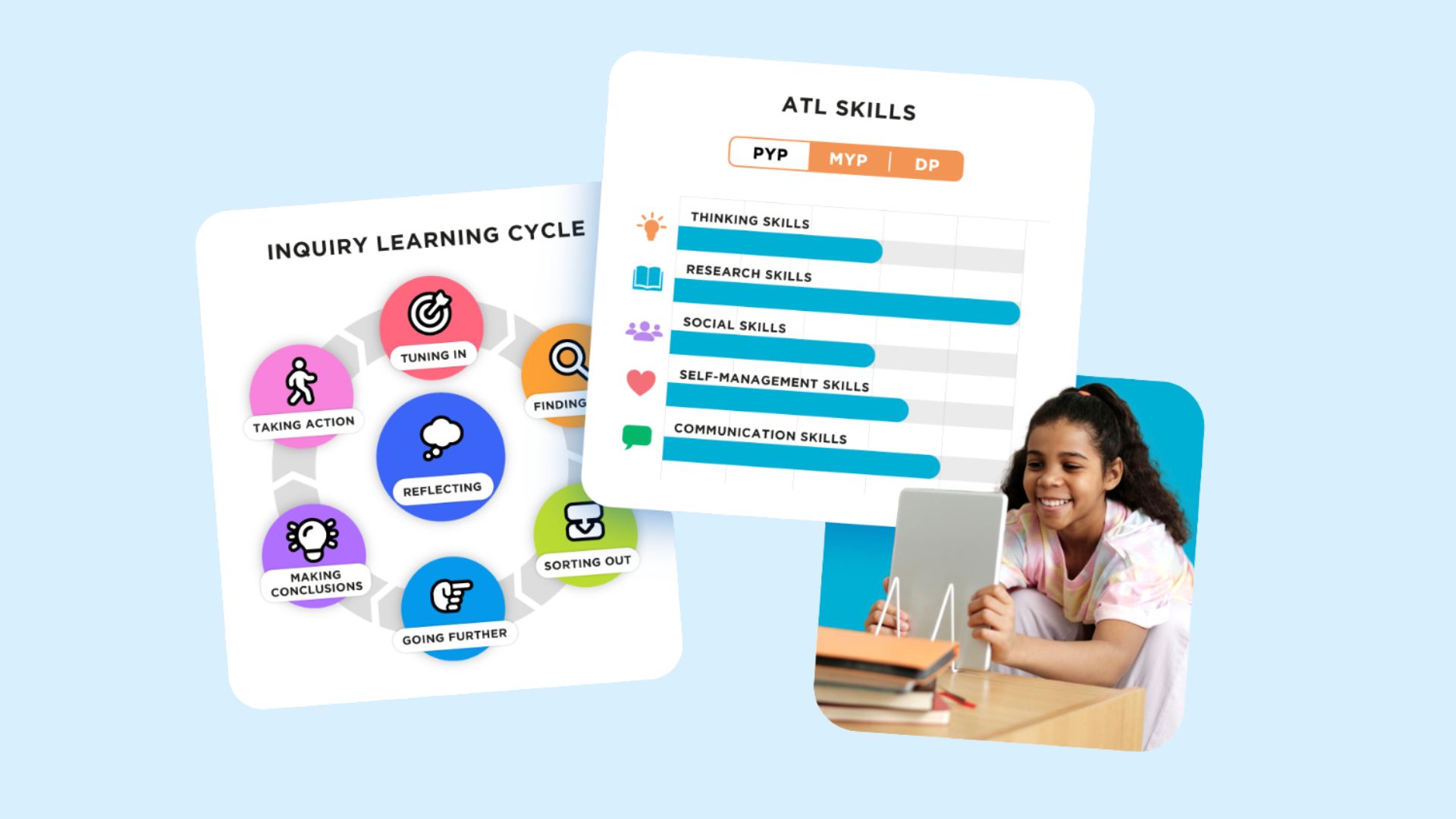
Qridi is a Finnish digital learning portfolio company whose platform is used by more than 100,000 students across more than 400 schools and organisations in over 20 countries. It is ISO 27001 certified, used in 20% of Finnish comprehensive schools, and adopted by the International Baccalaureate, European Schools (Schola Europaea), and school networks including Nord Anglia Education.
The core design principle behind Qridi is straightforward: make skills visible. Not just academic results, but the transversal competencies, self-assessments, and evidence of learning that traditional grade books cannot capture.
In practice, the platform works across three groups who all need different things from a learning portfolio:
%20Structured%20portfolio.jpg)
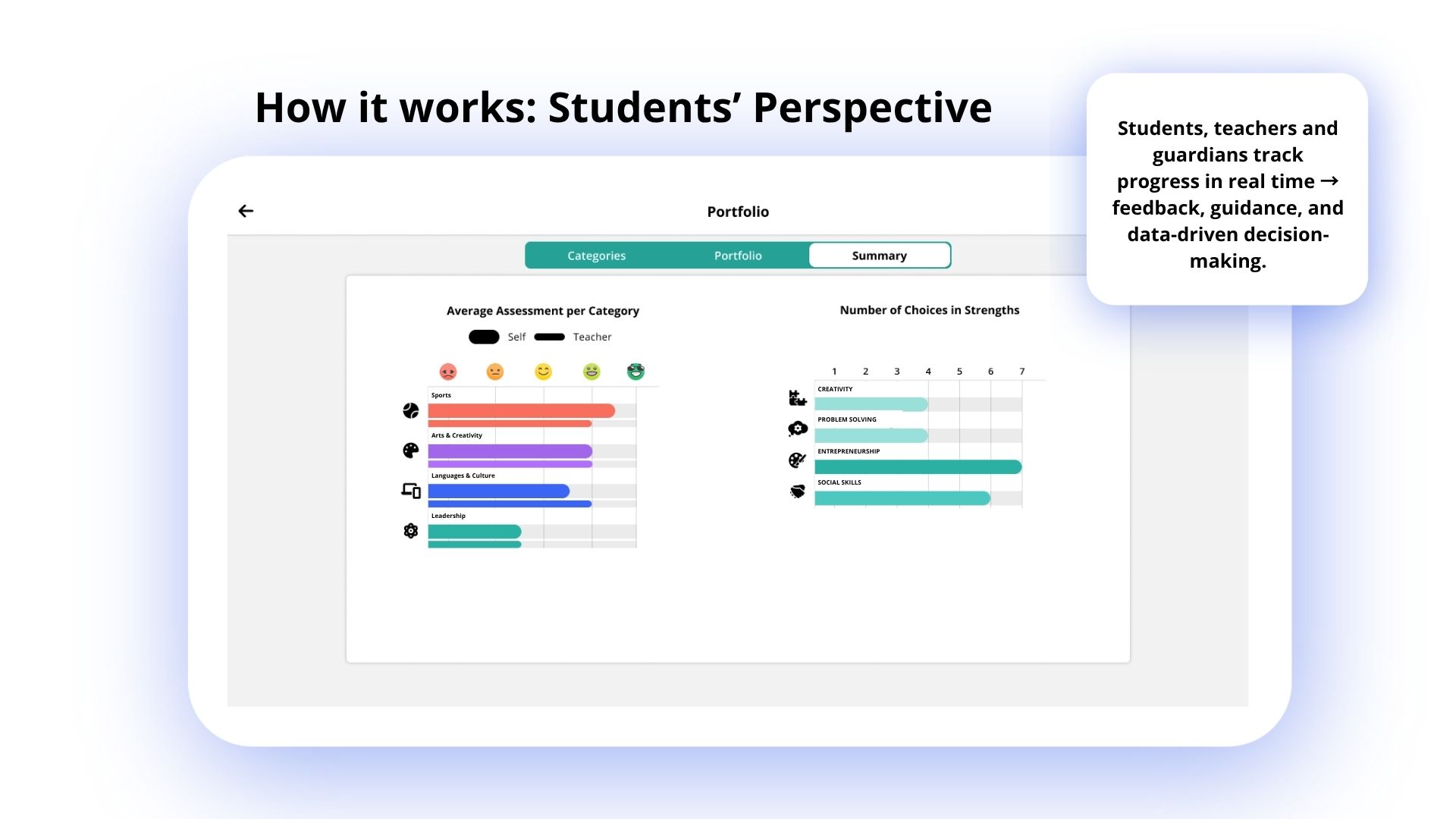
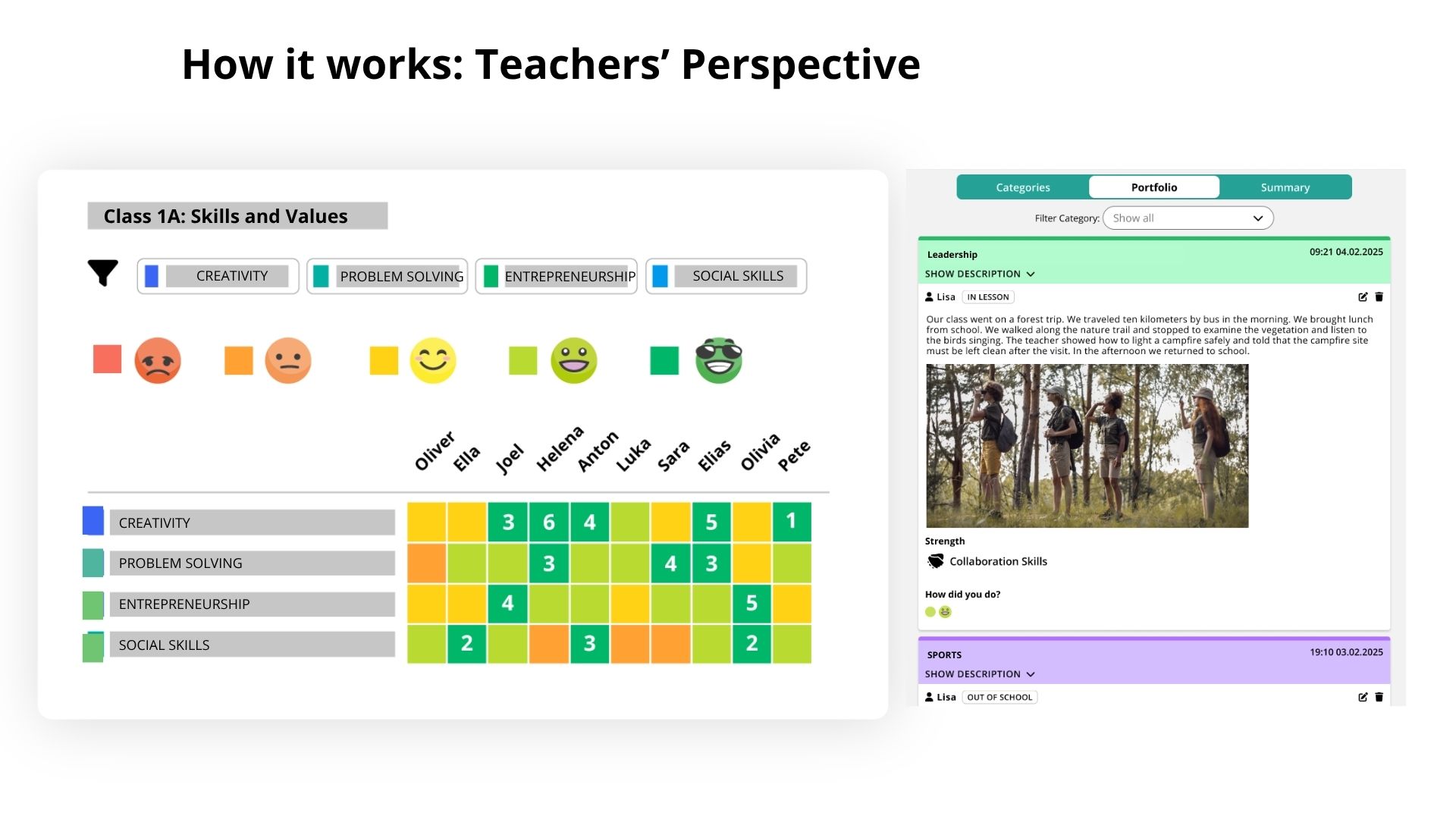
The platform includes ready-made templates for IB programmes (PYP, MYP, DP), inquiry learning cycles, STEAM projects, design cycles, and bespoke structures for school networks like Nord Anglia Education. The interfaces can be fully branded and white-labelled, which is why institutions from Abu Dhabi to Oxford to Helsinki use it under their own identity.

Altman’s industrial revolution parallel is worth sitting with. In the 1800s, the skills that made someone valuable before mechanisation, physical endurance, manual dexterity, the ability to do repetitive tasks well, were rendered largely redundant by machines. But the next generation did not simply become unemployed. They became the engineers, the artists, the organisers, the entrepreneurs who shaped a new kind of economy.
The same dynamic is playing out now. Rote knowledge retrieval, standardised test performance, and the ability to execute well-defined procedures are increasingly within reach of AI systems. What is not within reach is the capacity to know what question to ask before anyone else knows what the right question is. To connect ideas across domains in novel ways. To understand what another human being actually needs. To persist through ambiguity with curiosity rather than anxiety.
These are not soft skills in the dismissive sense. They are the hardest skills to develop, the hardest to measure, and the most important to prioritise. And they require a fundamentally different approach to how schools document and reflect on learning.
A student who learns how to learn will never be made obsolete by a technology shift. That is the bet Altman is making. It is also the bet that Qridi and Nord Anglia Education have been acting on.
Altman’s interview is a useful provocation, but provocations require responses. Here are three concrete directions school leaders and educators can act on today.
Metacognition needs to be treated as a curriculum objective in its own right. That means building structured reflection into lessons and projects, not just at the end of a term. The Nord Anglia model, which used Qridi to structure goal setting, evidence capture, and reflective review across a two-year research project, is a strong template for how this can be operationalised at scale.
Students who can see their own progress are more motivated, more self-aware, and better equipped to adapt. A digital learning portfolio that captures not just what a student produced but how they thought about it, what strengths they drew on, and how they would do it differently next time, is a fundamentally different artefact from a grade or a report card.
Teachers need to be able to see patterns across a class, not just manage individual portfolios. Parents and school leaders need access to progress insights that are meaningful and timely. The right platform makes all of this possible without adding significant workload. That is what Qridi is designed to do.
Sam Altman has spent his career betting on human potential in the face of technological disruption. Based on every historical precedent, he says, that is still the right bet to make.
For educators, the question is not whether to prioritise the skills that make students irreducibly human. That question has already been answered. The question is how to do it systematically, how to make it visible, and how to build the evidence that these interventions work.
Qridi exists to answer that question. The Nord Anglia Education Metacognition Project, conducted with Boston College across 27 schools, shows that it can be done at scale, with scientific rigour, and with results that make a genuine difference to students’ learning and wellbeing.
The most valuable meta-skill anyone can build right now is learning how to learn. Schools that build the systems to teach it, document it, and celebrate it will be the ones that prepare students for a future nobody can fully predict.
Further Reading
Qridi digital learning portfolio
Nord Anglia Education Metacognition Project
Full Business Insider interview with Sam Altman
EEF Metacognition and Self-Regulated Learning Guidance Report
Want to see how Qridi makes skills visible in your school? Book a free demo at www.qridi.com or contact Juhani Katajamaki, Director of International Projects, at juhani@qridi.fi